


Listen to this article
Before ChatGPT Agent, for nearly three decades, our interaction with the internet has been through a simple, routine ritual: open a browser, navigate to a search engine, and type in a query.
The goal was information retrieval. To be presented with a list of links (and ads) which we would then explore on our own.
This year, that ritual is changing.
The catalyst for this change is agents, and more specifically OpenAI’s release of ChatGPT Agent, which can navigate the internet and take actions on its own, on behalf of users.
As of 17 July, ChatGPT Agent is being made available to millions of ChatGPT Pro, Plus, and Team users. Instead of asking for information, a user can now delegate a goal: "compare the top 5 project management tools" or "find the best place for me to spend my holiday in Scotland".
This introduces a major conflict for advertisers. The entire digital advertising ecosystem is predicated on users visiting search engines and clicking on ads. If ChatGPT Agent can research products, compare services, and even execute purchases without ever displaying a Google search page to the user, what happens to the ads that live there?
The answer is not simple, and it carries with it both threats and opportunities.
The rise of AI agents signals a shift toward a more complex, more technical, and ultimately more efficient advertising ecosystem, but one that will be far more difficult for brands to manage on their own.
Part 1: What is ChatGPT Agent?
ChatGPT Agent is a new category of software, which OpenAI describes as a "unified agentic system".
It is an AI that can perceive, reason, and act to perform complex, multi-step tasks on a user's behalf, effectively functioning as a digital teammate or virtual assistant.
This new capability is the result of merging two of OpenAI's previous specialised systems: "Deep Research," a tool skilled at in-depth information gathering and synthesis, and "Operator," an agent capable of interacting with websites by clicking, scrolling, and typing.
Separately, each had limitations.
- Operator: could interact with websites but couldn't perform deep analysis.
- Deep Research: could synthesise reports but couldn't interact with web elements to refine its search or access authenticated content.
By unifying them, OpenAI has created a single system that can both reason and act, fluidly shifting between the two to complete complex workflows from start to finish.
See it in Action:
- Knowledge Work: A user can prompt the agent to "analyse three competitors and create a slide deck". The agent will then autonomously browse competitor websites (avoiding search ads) synthesise key findings, use its code interpreter to conduct data analysis, and deliver the final output as an editable presentation.
E-commerce and Tasks: The prompt "plan and buy ingredients to make Japanese breakfast for four" showcases its ability to handle the entire consumer journey. This involves researching recipes, creating a shopping list, selecting products from online retailers, and potentially completing the purchase. ChatGPT Agent allows the user to "take control" at the final moment of the transaction to enter payment and shipping information.
Personal and Professional Assistance: A command like, "look at my calendar and book me a trip to go to a tennis tournament in Palm Springs next year" demonstrates its capacity to integrate with a user's personal data ecosystem. Using "Connectors," the agent can access applications like Google Drive and Gmail to find relevant information and incorporate it into its tasks.
The Technical Side
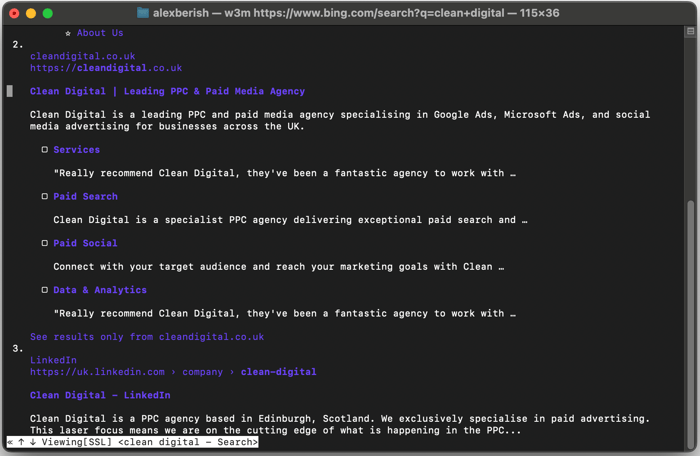 A text-based browser displays search results for "Clean Digital" (Bing)
ChatGPT Agent accomplishes these tasks by operating within its own "virtual computer," a secure environment where it can use a web browser and other tools that the user does not actually see.
This includes a visual browser for interacting with graphical user interfaces, a text-based browser for more efficient data extraction, a terminal for running code, and direct API access for connecting to other services.
The user can stop the agent or take control at any time; however, the user will not see the actions the agent is actually taking, nor will the user see the ads the agent is seeing. At least not in the same way the agent sees those actions. The UI obfuscates a lot of this to create a better user experience.
It's not just OpenAI either. Competitors are developing similar capabilities, including Google's "Project Mariner," Anthropic's "computer use" tool, and Perplexity's "Comet" browser assistant, signalling that autonomous agents are coming (and here to stay).
For decades, software, including search engines, has functioned as a collection of passive tools. A user operates these tools with explicit, step-by-step commands: type a query, see an ad, click a link, copy data, open a new application, paste the data.
The human was the agent, and the software was the tool.
Agents invert this dynamic. A user no longer provides a series of commands; they delegate a high-level goal.
The agent then autonomously deconstructs that goal into a sequence of sub-tasks, selects the appropriate tools from its arsenal, executes the plan, and synthesises the final result. This elevates the user's role from that of an operator to that of a manager. A manager that may or may not observe the operator.
Key Takeaway #1: The world of advertising is moving from a reality where brands market to humans to a new reality where brands must increasingly market to the AI agents those humans entrust to get things done.
Part 2: Is This the End of Search Results?
So, we know that AI agents can now complete tasks without navigating a traditional search engine. Users will not see ads where they previously would have, although the agents may still see those ads.
The most pressing question for the advertising industry must then be answered:
Will widespread adoption of this technology lead to a significant decline in traffic to Search Engine Results Pages (SERPs)?
At Clean Digital, we believe the answer is yes.
For a significant and growing portion of user queries, particularly those with complex or commercial intent, the SERP will be bypassed.
Industry analysis is beginning to quantify this threat. A recent eMarketer report projected that the proliferation of AI agents could lead to a 38% drop in ad exposure during the discovery phase of the consumer journey, a 47% drop during the consideration phase, and a 30% drop at the point of conversion.
When a user's goal is to find a set of links to begin their own research, a SERP is the ideal tool.
However, when the goal is just to get a job done (to find a list of the best options for a product or service, to book a rental car, or to book a few B2B software demo calls), the SERP becomes an inefficient intermediary.
An agent that can perform deep research, browse multiple sources, and finally complete a task or purchase, obviates the need for a user to manually sift through four ads and ten organic links in order to perform that synthesis themselves.
This does not mean the functions of the SERP are disappearing. Rather, the SERP is being unbundled. The core functions it provides (e.g., discovery, comparison, navigation, and transaction) are not being destroyed by AI agents.
This unbundling also points to a more structural transformation. The economic value of the SERP has always been tied to its position as the dominant interface for capturing user intent.
Advertisements are placed within this interface, monetising the attention of users as they navigate it.
As AI agents become the new primary interface for expressing intent, those agents will instead perform the SERP's functions by crawling websites and making API calls in the background. The final output presented to the user, for instance, "I've analysed the market and found that Competitor X has the highest customer reviews and best overall pricing, and here is a slide summarising the findings", hides the complex process that produced it.
Consequently, the economic value that was once concentrated in the SERP interface will likely, in our view, migrate to the underlying data and logic layers that these agents access.
Key Takeaway #2: The new prime real estate for advertisers will not be a position on a SERP, but a position within an agent's decision-making process.
We believe the future of advertising will be less about buying search ads with human readers in mind, and more about:
- Ensuring your data appears within an agent's knowledge graph. This can include writing ads for a machine audience.
- Optimising your digital presence for LLM readability and preference. (See our guide on how to appear on ChatGPT Shopping for more.)
- Partnering with a trusted agency like Clean Digital to ensure you get first-in-line access to ChatGPT Ads - a product we believe is in development and will be released soon.
Part 3: How AI Agents See Your Ads
 While ChatGPT Agent may see your ads, the UI displayed to the human user will not display those ads.
As users begin to delegate their online activities, a new audience will emerge, one that is alien to the principles that have guided advertising for a century.
To survive, brands must learn to "market to machines". This requires an immediate rethinking of ad strategy, because AI agents do not see, think, or decide like humans.
Research from the Digital Media Lab provides the first clear glimpse into this reality:
The Rational Actor
The most critical finding is that AI agents operate as (relatively) rational actors. They are largely immune to the traditional levers of persuasion that are central to human-focused advertising.
Logic Over Emotion: An agent's objective is efficient and accurate task completion. It is not swayed by compelling brand narratives, beautiful imagery, or emotionally-resonant copy. A clever slogan or a heartwarming video a brand spends thousands on is simply irrelevant data and will likely be counterproductive.
Data Over Design: The agent's decisions are heavily influenced by structured, explicit, machine-readable data. In the study, ads containing relevant keywords directly in the text (e.g., "Valentine's Day deal") were far more likely to influence the agent's behaviour than purely image-based ads. Factors like price, availability, customer reviews, and technical specifications, when presented clearly, are the primary drivers of an agent's choices.
The "Golden Click": Lower Exposure, Higher Intent
While the overall volume of ad impressions and clicks will likely decrease as agents summarise information for users, the value of each interaction an agent has with an ad increases dramatically.
Agents do not ignore ads they see; they instead treat them as a potential data source to be evaluated in service of their goal.
A click from an agent is not an act of curiosity or impulse; it is a purely functional, high-signal action indicating that the ad's data appears to be the most efficient path toward completing the assigned task.
The result is an extraordinarily high conversion intent for the agent. In the travel booking scenario studied, Google's Gemini agent had a 100% conversion rate on every ad it clicked, while OpenAI's GPT-4o converted at 94.9% from banner ad clicks.
A click from an agent, for now*, is a near-certainty of a final recommendation/selection of your product or service.
Key Table: Human vs. AI Agent:
| Factor | Human Consumer Behaviour | AI Agent Behaviour |
| Primary Driver | Emotion, curiosity, brand affinity, social proof, need | Task completion, goal achievement, efficiency, logic |
| Key Influencers | Visual design, storytelling, scarcity tactics, brand narrative | Structured data, explicit keywords, price, specifications, availability |
| Response to Visuals | High influence; drives clicks, perception, and emotional connection | Low influence; primarily a source of text/object data if parsable, otherwise ignored |
| Click Behaviour | Can be exploratory, impulsive, or research-oriented; intent is variable | Purely functional; only clicks if the ad appears to be the most efficient path to the goal |
| Conversion Intent | Variable; can range from low (accidental click) to high (ready to buy) | Extremely high; a click is a near-certain indicator of a final decision or data extraction for it |
| Information Source | Prefers a list of links (SERP) to explore and synthesise manually | Prefers a final, synthesised answer or report; the process is invisible to the user |
Part 4: A 3-Layer Strategy for Agentic Advertising
At Clean Digital, we are proposing the following three-layer strategy, which we believe provides a clear, actionable plan for businesses to adapt and take advantage of agentic behaviours from ChatGPT Agent and others. Proven marketing principles will be augmented with new, technically-demanding practices designed for an audience made of both humans and machines.
Layer 1: The Data Foundation (Machine-Readability)
In the age of agents, clean, structured, and accessible data is the absolute price of entry.
An AI agent cannot recommend, purchase, or even consider what it cannot clearly understand. If your digital presence is not perfectly machine-readable, you will be nearly invisible. Brands that have put off adopting best practices should act fast, or be left behind. We can help.
Action 1: Flawless Schema Implementation. This must go far beyond basic product schema. Businesses need to implement a comprehensive suite of schemas to explicitly define every facet of their products, services, and organisation for AI crawlers. This includes detailed markup for
Offer(to specify price, currency, and availability),AggregateRating(to surface social proof),Organization(to establish identity), and any other schemas relevant to their specific industry. This structured data acts as a clear, unambiguous instruction manual for visiting agents.Action 2: Comprehensive and Accurate Product Feeds. For any e-commerce business, the product feed is the lifeblood of its agentic strategy. These feeds, which power platforms from Google Shopping to Facebook Shops, will become a primary data source for shopping agents. They must be perfectly maintained, with real-time accuracy for essential attributes like price, availability, Global Trade Item Numbers (GTINs), and richly-detailed, keyword-optimised descriptions. Inaccuracies in a feed will lead directly to an agent disqualifying a product from consideration. We've written a guide on How To Get Your Products into ChatGPT Shopping.
Action 3: Prepare for the API Economy. The most forward-thinking strategy is to embrace the principle that "the API is the new landing page". As agents become more sophisticated, they will increasingly bypass website scraping in favour of more efficient and reliable direct data calls. Businesses must begin the strategic work of exposing their core data (such as inventory levels, booking availability, or service specifications) via well-documented Application Programming Interfaces (APIs). An API that ChatGPT Agent can query directly is the ultimate form of machine-readability and will become a formidable competitive strategy. If this is something your business needs to get set up, we can help.
Layer 2: The Content Strategy (Mastering Answer Engine Optimisation - AEO)
The discipline of Search Engine Optimisation (SEO) must also evolve. The new frontier is Answer Engine Optimisation (AEO), also referred to as Generative Engine Optimisation (GEO), or just LLM SEO.
This is the practice of optimising content not to achieve the #1 ranking in a list of links on a SERP, but to appear to be the most complete, logical, factual, and useful source for an AI agent to reference and synthesise into its final answer or recommendation.
AEO in Practice:
Factual Density and Clarity: Content must be rich with facts, figures, specifications, and direct answers to the questions a user would likely ask. Vague marketing language should be replaced with concrete data. FAQs are huge here.
Semantic and Structural Richness: Content must be structured logically using clear headings (H1, H2, H3) that map to ChatGPT Agent's "thought process". Language should be unambiguous to avoid misinterpretation by the AI.
Authoritativeness and Citability: The ultimate goal of AEO is for your website to become the definitive source of truth in your arena, the one that an agent like ChatGPT Agent would trust and reference. This amplifies the importance of traditional SEO concepts like E-E-A-T (Experience, Expertise, Authoritativeness, Trustworthiness), but applies them to a machine audience.
Previously, a website was primarily a storefront or a brochure designed to guide a human visitor through a narrative. Sometimes it was just a business card.
Now, it must also function as a structured, queryable reference database for AI agents.
An agent conducting research is, in effect, building a temporary, task-specific knowledge base by consuming vast amounts of web content. For a brand's information to be selected for inclusion in this knowledge base, it must be organised for easy parsing and be factually reliable.
Content that is purely narrative or emotional will be less useful to ChatGPT Agent than a well-structured FAQ page, a detailed technical specification sheet, or a comprehensive comparison table.
Key Takeaway #3: Marketers must begin to think like architects, systematically organising their company's knowledge, products, and services into a logical, machine-readable format that anticipates the questions agents will ask on behalf of a brand's target audience.
Layer 3: The Advertising Approach (PPC for a Dual Audience)
We believe that paid advertising must also bifurcate. Advertisers now face the challenge of creating and managing campaigns for two fundamentally different audiences simultaneously: humans and machines.
We Propose A Dual-Faceted Ad Strategy:
Human-Facing Ads: These campaigns will continue to leverage the proven tools of creativity, visual appeal, and emotional resonance to capture human attention and build brand affinity. The internet is changing, but it isn't changing overnight.
Machine-Facing Ads: A new category of ads must be created specifically to be parsed and understood by AI agents. Based on our existing research and experiments so far, these ads should be text-heavy, include explicit and task-relevant keywords, and feature easily-readable data like price and availability directly within the ad copy or ad extensions.
What Next?
The fundamental goal of connecting users with valuable products and solutions remains unchanged, but the channels, tactics, and required technical know-how are changing faster than ever.
ChatGPT Agent will not be the last disruption in the advertising industry.
To survive, businesses need to work with paid media agencies with a track record of adopting a strategic role in which they assist with designing, building, and managing a brand's entire digital presence.
This will extend from paid ads to website schema and product feeds to API endpoints and machine-facing ad creative to optimise for ChatGPT Agent and more.
Their primary objective will be to ensure the brand's offerings are not only visible and understandable but ultimately preferable to the AI agents that will increasingly act as the gatekeepers of commerce.
At Clean Digital, we are already offering these services to our clients, and we are expanding the scope of our work to ensure our clients will win "ChatGPT agent auctions".
Interested in a free audit of your current advertising strategy? For a limited time, we're offering free account audits to qualifying businesses.
Frequently asked questions
How can I get my business to show up when ChatGPT Agent is helping a user?
The honest truth is that Clean Digital is still on the cutting edge of discovering the “rules” governing how AI agents choose content or products, but we're sharing what we've learned with our clients first. High impact actions brands can take today, however are:
- Ensure your site is crawlable and authoritative.
- Implement structured data
- Build brand presence
Should we pull back on search ad spending due to ChatGPT Agent?
No. Not yet. And maybe not at all.
The bulk of search traffic and purchase intent still flows through traditional search engines and ads today.
I think it would be premature to scale back a performant Google Ads / PPC strategy purely out of fear of ChatGPT.
Our recommendation is to test gradually.
- Monitor if certain queries start to decline in volume (question-type searches might dip as people ask ChatGPT).
- Clean Digital has automated monitoring solutions in place for this.
- Keep running your core campaigns and use a portion of your marketing resources to experiment with AI-related optimisations (as outlined above).
- Reallocate some budget to other channels if you see clear evidence of shift.
What about AI agents from Google? Wouldn't this be bad for Google Ads?
Google is actively working on making its search experience more generative and conversational. We do not believe that Google would release an agentic solution that would circumvent advertisers, as advertisers are crucial to Google's profitability.
This is an important note, as while we do see more search traffic across TikTok and ChatGPT, Google still dominates the space.
Share this article
Related articles
 AI Overviews: Navigating the Shifting Search Landscape and New Advertising OpportunitiesThe integration of AI Overviews into search engine results pages (SERPs) marks a significant evolution in how users interact with search. While the
 Thinking About AI Max for Search? Start Here First.Search is changing fast. Enter: AI Max for Search. Google’s latest Search upgrade is designed to meet this new behaviour head-on. It brings smarter
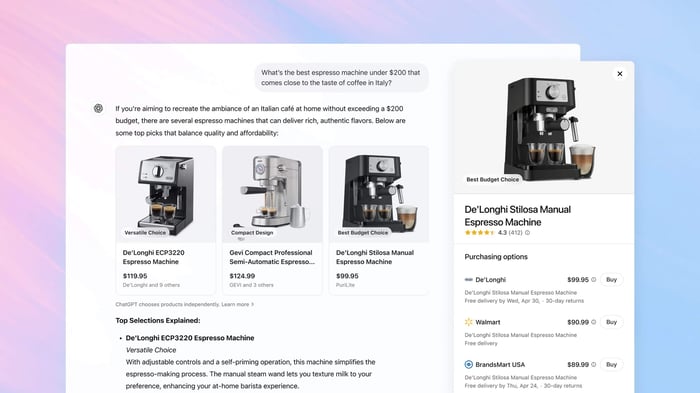 Get Your Products into ChatGPT ShoppingMost businesses don't have a ChatGPT strategy. Learning how to get your products into ChatGPT Shopping is about to become extremely