



The automation hangover
Across agencies up and down the country, conversations are being had about what the future of a Paid Media professional looks like in the context of an increasingly automated industry. Gone are the days of manually adjusting keyword bids (and have been for quite a while), but have the traditional Google Ads metrics used for managing campaigns and adjusting strategy gone for good? Or are they undervalued skills which need revisiting?
As of writing (March 2026), Google Ads is almost entirely automated. For many advertisers, this has created a quiet assumption that old Google Ads metrics no longer matter. Quality Score feels historical. CTR feels irrelevant. Visibility metrics feel disconnected if you are bidding for a conversion target.
That assumption is flawed.
Legacy metrics have not lost value because automation took over. They have lost control. And that distinction matters. In an environment where you can’t manually steer every lever, the ability to interpret what the system is doing becomes the real advantage.
Old Google Ads metrics still win in 2026 - not because they dictate outcomes, but because they reveal causes. They provide the context needed to build beyond surface-level recommendations and truly understand performance dynamics.
What “old Google Ads metrics” actually mean in 2026
When I say old Google Ads metrics, I’m not talking about long-lost metrics like Page Position but still widely available metrics you don’t hear as prominently in discussions as you did 5-6 years ago. To name but a few, for example:
- Quality Score and its components.
- Click-through rate (CTR).
- Auction and visibility metrics.
- Landing page experience.
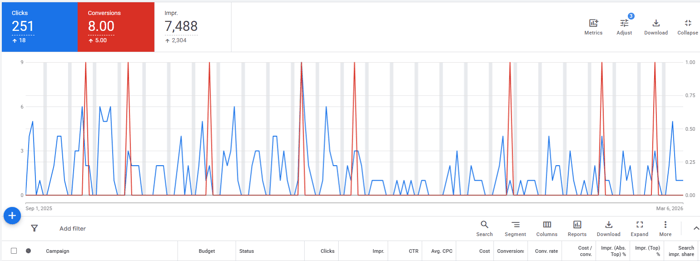
In 2026, these are no longer levers in isolation. You are not optimising them through manual tweaks or chasing thresholds for vanity. Instead, they function as diagnostic indicators.
You influence them indirectly - through stronger relevance, clearer messaging, and better landing experiences - not through direct manual control.
Think of them as inputs into Google’s decision-making rather than targets for manual optimisation. They describe how the system perceives relevance, usefulness, and value. That perception still governs cost, eligibility, and scale, even if the mechanics are hidden. When was the last time a member of your team assessed landing page experience against their broad match keywords and thought, “Maybe the missing CPCs & CPAs aren’t due to high competition, but actually, there’s fundamentally an issue with the landing page?” As to this day and likely always, conversion rate is key.
Quality Score as a relevance health check
Quality Score still rolls up three fundamentals:
- How well the query matches intent.
- How relevant the ad is to that intent.
- How effectively the landing page delivers on the promise of the ad.
Those fundamentals have not changed. What has changed is how quickly poor relevance compounds and how hardly anyone takes note.
Low Quality Scores still correlate with higher CPCs and unstable delivery. Automation accelerates what’s already present. Strong relevance compounds positively. Weak alignment compounds negatively. Broad match and automated expansion push your ads into wider intent pools. When relevance weakens, the system pays more to find converters and performance becomes volatile; quality score still impacts the final cost you’re paying to win the auction.
One of the most useful signals in 2026 is not the Quality Score number itself, but its direction. Downward trends often appear before performance collapses. They are frequently the first indicator that matching has drifted too far or that messaging no longer aligns with how queries are being interpreted.
Used properly, Quality Score is not a KPI. It is an early warning system.
CTR is not dead; it has just changed jobs
CTR used to be treated as a blunt optimisation metric. Higher was better. Lower was bad. That framing is outdated, but the signal itself is not.
Today, CTR is best understood as a creative and intent alignment metric. It shows how users respond to the traffic automation is choosing to send you.
When CTR declines consistently, it often exposes a mismatch between query intent and ad messaging. In many accounts, sustained CTR erosion precedes conversion rate drops. The system continues buying traffic, but engagement weakens before efficiency visibly drops.
This matters across modern formats. Demand Gen, Performance Max, and broad match all rely heavily on user response signals. Click behaviour remains one of the clearest expressions of perceived relevance. Creative testing still matters, even when bidding does not. Ignore it at your peril.
CTR no longer tells you how good your ads are in isolation. It tells you whether automation is still pointing them at the right people.
SERP visibility still dictates volume
Average position may be gone, but visibility has not disappeared. It has simply been reframed.
Impression share, top of page rate, and absolute top of page rate still define how often you are present and where. When performance plateaus, these Google Ads metrics frequently explain why.
Lost impression share due to budget indicates demand is there, but spend is constrained.
Lost impression share due to rank shows when relevance, bids, or targets are holding you back (and quality score!).
These distinctions matter. In many accounts, default response to stagnation is to increase tCPA or lower tROAS. But if the underlying constraint is coverage or relevance, bid adjustments alone won’t unlock scale.
Visibility metrics reveal when automation is deprioritising a campaign entirely, and whether growth is structurally possible or artificially capped.
Landing page experience is the forgotten multiplier
Landing page experience is arguably more important in 2026 than it was a decade ago.
Automation sends broader traffic by design. Pages that convert narrow intent extremely well often fail when exposed to that breadth. They rely on users arriving already convinced..
Page speed, message match, and intent clarity now influence more than conversion rate. They feed back into Quality Score and auction outcomes. Poor pages increase costs and reduce eligibility long before conversion data becomes statistically clear.
Treating the landing page work as a CRO side project misses the point. Strong pages give automation room to explore without destroying efficiency. Keep this at the forefront of any campaign optimisation, and you’ll see great improvements in conversion rate will follow.
The automation generation problem
Across the market, we are seeing a growing over-reliance on target adjustments as the primary response to performance shifts.
Many newer practitioners have grown up in a world where adjusting tCPA or tROAS is the primary response to performance issues. Structural diagnostics are skipped because automation is assumed to handle them, but also, those who teach them have also become accustomed to automation and smart strategies doing the heavy lifting.
This is not laziness. It is over-reliance.
Adjusting targets is fast and often produces short-term movement. But it treats symptoms, not causes. Rising CPCs can be masked by smart bidding. Relevance decay happens gradually. Volatility only becomes obvious when market conditions shift.
Without diagnostic discipline, accounts drift until they break. Normally resulting in clients leaving or strained relationships.
To conclude, returning to fundamentals is a competitive edge
Automation has not removed the need for understanding. It has increased it.
Old Google Ads metrics are not outdated. They are the framework for interpreting a system you no longer directly control. Marketers who can read those signals, rather than blindly adjusting bidding targets, gain stability, scale, and long-term performance advantages in 2026.
Back to basics is not regressive. It is how you move forward when the controls are no longer in your hands.
The agencies that thrive in 2026 aren’t fighting automation.
They are interpreting it - and structuring accounts accordingly.
If you’d like to learn more, get in touch, and please follow us for more digital marketing related content!
Frequently asked questions
Is Quality Score still relevant in an automated Google Ads environment?
Yes, but its role has shifted. In 2026, Quality Score acts as a "diagnostic health check" rather than a manual lever. It reveals how Google’s AI perceives your relevance; a declining score is often an early warning sign that your messaging or landing page is no longer aligning with the intent of the traffic automation is finding.
Should I still track Click-Through Rate (CTR) if I’m bidding for conversions?
Absolutely. While CTR no longer dictates outcomes in isolation, it remains the primary metric for creative and intent alignment. If your CTR is eroding while the system is still buying traffic, it indicates that the automation may be drifting into the wrong audience pools or your creative is failing to engage users.
How do visibility metrics like Impression Share help with automated campaigns?
Visibility metrics provide the structural context for performance plateaus. They help you determine if a lack of growth is due to budget constraints (Lost IS due to Budget) or fundamental issues with rank and relevance (Lost IS due to Rank). Understanding these prevents the common mistake of simply raising bid targets when the real issue is account structure or quality.
Share this article
Related articles
 Clean Digital Achieves Google Premier Partner StatusOur recent Google Premier Partner status, awarded by the Google Partners programme, represents the highest tier available to agencies managing Google Ads
 Creative Is the New Targeting: How to Build Meta Ads That Actually ConvertWith Advantage+ and machine learning now driving distribution, the competitive edge has moved. You can no longer out-target the competition; you have to
 Why UGC Ads are the Future of Brand MarketingAudiences have become more sceptical of traditional advertising and more receptive to content that feels real, relatable and trustworthy. Studies show