


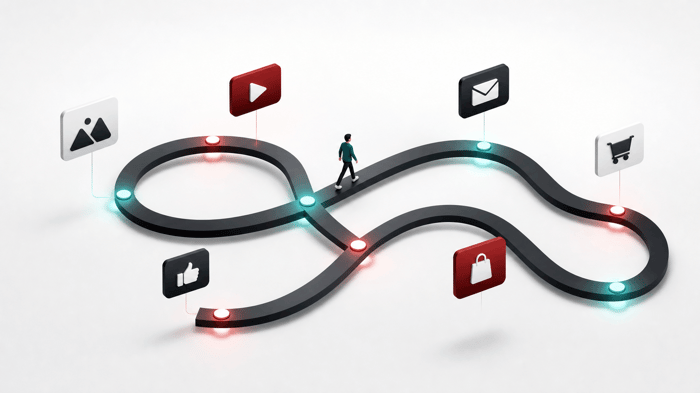
There’s a bit of a pattern in PPC. Every couple of years, something gets labelled as “outdated”. Budgets shift, attention moves elsewhere, and suddenly a channel that used to be core becomes an afterthought. Display advertising has been sitting in that category for a while.
It’s often seen as inefficient, hard to measure, or something you run because you feel like you should rather than because you actually believe in it. And if you’re looking at it purely through a last-click lens, it’s easy to see why. But that’s not really how display works, and more importantly, it’s not the job it was ever meant to do.
Search vs. Display
The mistake most people make is treating display advertising like search. In PPC, different channels serve entirely different stages of the customer journey:
- Search is where you capture demand. Someone knows what they want, they go looking for it, and you show up at the right moment. It’s direct, measurable, and easy to justify.
- Display advertising sits on the other side of that. It’s about creating demand, or at the very least influencing it before it fully forms. It’s the reason someone recognises your brand when they eventually search, and the reason they click your ad over someone else’s. More often than not, it’s doing that without ever getting the credit.
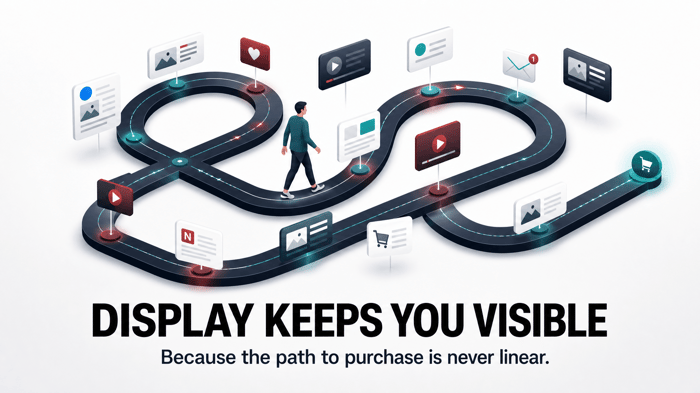
That disconnect is why display gets undervalued. If you judge it on clicks alone, it will always look weaker. But most people don’t click the first time they see something. They scroll past, they forget, they come back later. The journey is longer, messier, and far less linear than most reporting makes it look. Display fits into that reality quite well, keeping your brand visible while people are still figuring things out. It shows up when they’re browsing, when they’re not actively searching, and when they’re open to influence but not ready to act. Over time, that familiarity builds, so by the time they do hit search, you’re not starting from zero.
The Hidden Impact of Display Advertising
In most PPC accounts, display rarely looks like the best-performing channel on paper, but remove it and you’ll often feel the impact elsewhere:
- Branded search softens as brand recognition dips.
- Return traffic drops because users aren't being reminded to come back.
- Conversion rates shift slightly across your broader funnel.
Nothing dramatic overnight, but enough to show it was doing more than it appeared. That’s where display starts to make more sense, not as a standalone performance channel, but as part of a wider system. It supports search by warming up audiences before they ever type a query, brings back users who didn’t convert first time, and extends the reach of other channels like paid social or video.
This role is becoming more important as the way people engage with brands continues to change. There are more channels, more distractions, and more competition for attention than ever. You’re not just competing in search results anymore, you’re competing everywhere. At the same time, trust is harder to earn. People are more sceptical of polished ads and more influenced by familiarity and repeated exposure. Display advertising sits quite naturally in that environment, not because it’s flashy or new, but because it’s consistent. It keeps you visible, builds recognition, and gives you more chances to be remembered.
Navigating Modern Challenges
Of course, it’s not without its challenges. Privacy changes are forcing a shift away from third-party data, which means targeting is evolving. AI is taking on more of the optimisation, raising the bar on inputs like creative and audience strategy. Measurement is also still catching up when it comes to properly valuing assistive channels. But none of that makes display less relevant. If anything, it just makes it more strategic.
It’s no longer something you can bolt on at the end of a PPC plan. It needs to be thought about properly, in the same way you’d think about search or paid social. What role is it playing? Where does it sit in the journey? How does it support everything else? Because if your entire PPC strategy is built around capturing existing demand, you’re only ever working with what’s already there.
Display helps expand that. It creates more entry points into your funnel, keeps your brand in front of the right people, and makes every other channel slightly more effective as a result. It’s not the easiest channel to justify on paper, but in practice, it’s often one of the most important. And in 2026, that’s unlikely to change.
If you’d like to learn more, get in touch, and please follow us for more digital marketing related content! Or you can subscribe to our newsletter.
Frequently asked questions
Why does display advertising get undervalued in PPC?
Because it is usually judged on a last-click basis, whereas its true job is to build brand awareness, create demand, and influence users before they actively search.
How does display advertising support search campaigns?
It warms up cold audiences and builds familiarity over time, resulting in higher brand recognition, stronger branded search volume, and better conversion rates.
Is display advertising still relevant with privacy and AI changes?
Yes. Privacy shifts and AI optimization make display more strategic, requiring smarter first-party data targeting and higher-quality creative inputs.
Share this article
Related articles
 Why Creative Matters in Paid MediaIn paid media, data and spend often get all the attention, but the role of creative is often overlooked. Without strong, engaging ads, even the biggest
 From Data to Doorstep. Your Next Location is Hiding in Plain Sight.Starbucks built an entire internal geospatial division to determine where their next cup should be served, layering foot traffic data, drive-time modelling,
 The PPC World Cup: Navigating Strategy During the TournamentBut while millions of eyes are glued to the world cup pitches, what is happening behind the scenes to your paid media accounts? Major sporting events can