



My colleague recently wrote about why old Google Ads metrics still matter in 2026 - touching on "CTR is not dead; it has just changed jobs" and I wanted to pull on that thread. Because I think it deserves its own conversation.
Let me set a scene for you. It's a Tuesday. Someone in a marketing meeting waves their hand and says "Oh, CTR? We don't really look at that anymore. We are letting the algorithm handle it." Everyone nods. Someone writes "trust the automation" in the notes. A small part of me dies. (Not you, obviously. You would never.)
Here's the thing about click-through-rate (CTR) in 2026: it has become very unfashionable to care about it. In an era of PMax, Smart Bidding, and Google essentially saying "don't worry about it, we have got this," the old metrics have been quietly shuffled to the back of the room. And that, I would argue, is a mistake.
It is not dead.
What CTR used to be, and what it actually is now
The old way of thinking about CTR was blunt: high is good, low is bad, chase the number. If you got a 10% CTR you were either a genius or you had accidentally written clickbait. Either way, celebrate. That framing is outdated, yes. But here's what a lot of people miss when they throw CTR overboard: the signal didn't disappear. It just changed jobs.
In 2026, CTR is best understood as a creative and intent alignment metric. It's not telling you how great your ad is in isolation. It's telling you whether automation is pointing your ads at the right people. When CTR starts dropping consistently, it's often the first sign that something has gone quietly wrong - that the queries being matched to your ads no longer match your messaging, that broad match has wandered somewhere it shouldn't, that the humans on the other end of the impression are looking at your ad and going ...nah.
And here's the really important bit: that signal appears before your CVR drops. The system keeps buying traffic. The clicks keep coming. But engagement weakens first, efficiency follows later, and by the time the CPA looks alarming, you have already been haemorrhaging relevance for weeks.
The four-part reality check
This is where CTR and CVR need to be read together, because either one in isolation will lie to you, and the lie is expensive.
Here's the thing nobody puts in the deck: CTR and CVR tell completely different stories depending on which direction they move together, and each combination means something specific.
- High CTR, high CVR? Great. Your message is landing and your page is delivering. Don't touch it, but do try to make it even better.
- High CTR, low CVR? This is the dangerous one, and the one most people miss. The dashboard looks lively. The clicks are coming in. But those clicks aren't converting, which means you are attracting the wrong people with a promise the landing page isn't keeping. That's not a win. That's a money pit dressed up as momentum.
- Low CTR, high CVR? Your message resonates well with the few people who actually click - but something in the ad itself is putting everyone else off before they get there. The opportunity is real. The copy just needs to open the door wider.
- Low CTR, low CVR? Remove it. It's dead weight, and keeping it is just a matter of politeness toward a bad decision.
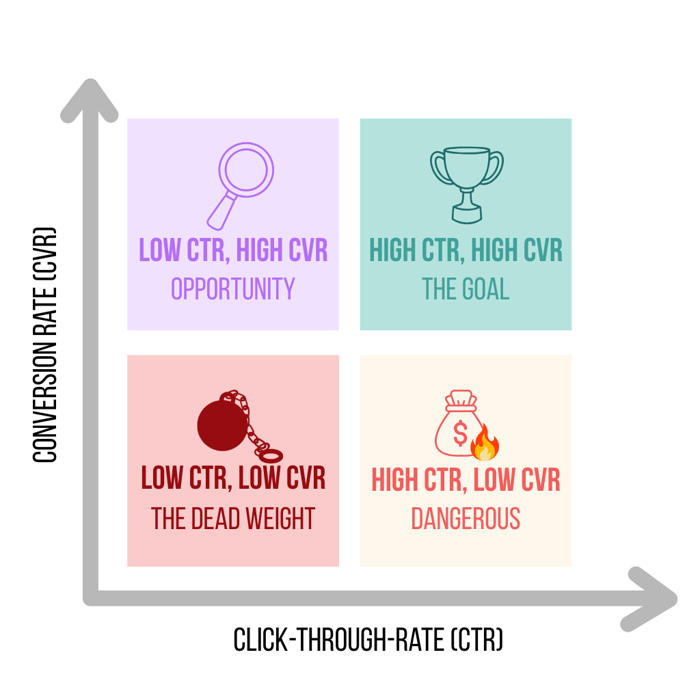
The point is: CTR without CVR is half a story. A high CTR with a collapsed CVR isn't a success metric - it's a diagnosis. It tells you very specifically that people found the hook interesting, but the reality didn't match. That gap between what the ad said and what the page delivered? That's where money quietly disappears.
The automation trap
There is a comforting lie that goes around in PPC circles, which is that because Google's bidding is smart, you only really need to pull the one lever: adjust the tCPA or tROAS target and wait for things to improve. And look, sometimes that works! Short-term, it can absolutely produce movement.
But it's treating symptoms, not causes. It's the equivalent of turning up the thermostat because your windows are open. The number changes. The underlying problem does not.
CTR, alongside Quality Score and landing page experience and all the other metrics that have been quietly demoted to "legacy" status, are diagnostic tools. They're not levers you pull - they are gauges you read. Callum covers this in detail - these metrics tell you why the system is doing what it's doing, which is considerably more useful than just watching what it does and hoping for the best.
The platforms themselves haven't abandoned CTR either. Google's AI weighs historical CTR to influence ad rank and Quality Score, and Meta uses it to train delivery algorithms. So while we have been arguing about whether it matters, the machines have been using it to make decisions about who sees what and at what cost. Might be worth paying attention to the thing the algorithm is paying attention to.
The number itself, since we are here
The average CTR for Google Ads is currently around 6.4%, with some industries like arts and entertainment reaching as high as 13% (Cropink). If you are sitting well below your industry benchmark and shrugging because "CTR isn't a real metric anymore," you are almost certainly paying more per click than you need to, reaching people less efficiently than you should be, and drifting toward a performance problem that will eventually become unignorable.
It doesn't have to be a KPI. It doesn't have to be the thing you report to clients every week. But it should absolutely be something someone is looking at.
So what do we actually do
Watch the direction, not just the number. A CTR that's trending downward is often the first warning sign before something more expensive goes wrong. It's the smoke detector. You don't ignore the smoke detector because it's not also putting out the fire.
Test your creative, even when you are not manually bidding. Write distinct headlines that each do a different job: one that matches the keyword, one that leads with a benefit, one that builds trust, one that speaks to a feature, one that tells people what to do next. Run them, then actually go back and look at what the CTR and CVR data is telling you about each one. Most advertisers write RSA headlines once and never look at them again. That's not testing. That's hoping.
And for the love of all things, look at your landing page. Because if CTR is holding up but CVR is falling, the ad is doing its job and the page is not. That's a solvable problem, but only if someone actually diagnoses it.
If you’d like to learn more, get in touch, and please follow us for more digital marketing related content! Or you can subscribe to our newsletter.
Frequently asked questions
Is a high CTR always a sign of a successful Google Ads campaign?
Not necessarily. While a high CTR indicates that your ad is engaging and relevant to the search query, it only tells half the story. If you have a high CTR but a low Conversion Rate (CVR), you are likely attracting the wrong audience or sending them to a landing page that fails to deliver on the ad's promise. CTR is a measure of interest, not intent to buy.
Why should I care about CTR if I use Smart Bidding and PMax?
Even in an automated environment, Google uses historical CTR to determine your Ad Rank and Quality Score. A declining CTR is a signal that your creative is fatiguing or the algorithm is matching your ads with irrelevant queries. By monitoring CTR, you can catch performance "drifts" weeks before they show up as an increase in your Cost Per Acquisition (CPA).
How can I improve a low CTR without changing my entire strategy?
Start by testing your creative assets. Ensure your Responsive Search Ads (RSAs) include a mix of keyword-heavy headlines and benefit-driven copy. Check your "Search Terms" report to see if broad match is triggering your ads for irrelevant phrases, and use negative keywords to prune that traffic. Often, a low CTR is simply a sign that your ad hasn't "opened the door" wide enough for the right audience.
Share this article
Related articles
 Why UGC Ads are the Future of Brand MarketingAudiences have become more sceptical of traditional advertising and more receptive to content that feels real, relatable and trustworthy. Studies show
 Making The Most Of First-Party DataBut what exactly is first-party data, why does it matter, and how can brands harness it to build trust and deliver better advertising? First-party data
 Clean Digital Achieves Google Premier Partner StatusOur recent Google Premier Partner status, awarded by the Google Partners programme, represents the highest tier available to agencies managing Google Ads