


AI has introduced a monumental shift in how people search, research, explore and arrive at decisions online, and for those of us working in PPC, the implications have been quietly building for some time.
While platforms like OpenAI initially signalled resistance to a traditional advertising model, many paid media specialists suspected that scale, cost and commercial pressure would eventually force the question of monetisation, particularly with Google nipping at their heels. What we are now seeing is the early shape of that transition. Ads are not arriving all at once, and they do not resemble traditional search placements, but the direction of travel is becoming clearer. As digital marketers, we are paying close attention, aware that access to these environments will matter, but also that timing and execution will be critical. This blog aims to track the current state of AI advertising, investigating where platform capabilities stand today and how paid media teams should frame the next phase of discovery.
Implications for 2026
As we move into 2026, AI advertising looks less like a sudden unlock and more like a period of careful experimentation. Monetisation is becoming unavoidable as these platforms scale, yet introducing ads into personal, conversational environments brings a different set of risks to those seen in search or social. Trust, user comfort and adoption all sit in a fragile balance, and 2025 showed how quickly assumptions can outpace reality. As a result, progress is likely to be measured and uneven, shaped by small pilots rather than broad rollouts, as platforms test where advertising can exist without undermining the experience. For advertisers, this is not about rushing to be first, but about understanding how AI-driven discovery is evolving, what signals truly matter, and where paid media can play a role that adds value rather than friction.
The 2026 Landscape of AI Advertising Platforms
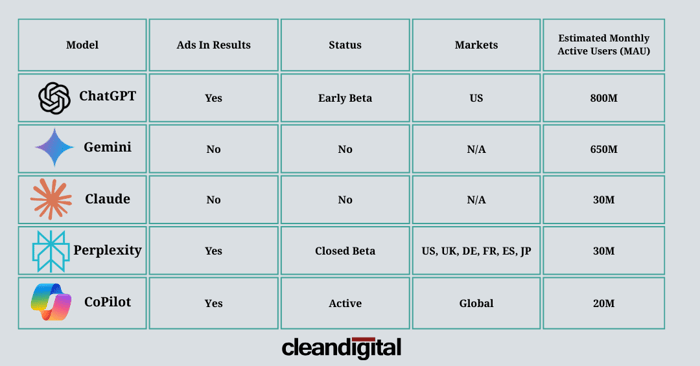
Supplementary information about the top channels
Google (Search, AI Overviews, AI Mode, Gemini)
- Google is currently the most advanced platform when it comes to integrating advertising into AI-driven discovery. Ads are already live within AI Overviews and are being tested in AI Mode, largely through existing Google Ads products such as Performance Max, broad match and automated campaign types. Rather than creating entirely new formats, Google is extending its existing ad ecosystem into AI surfaces, reinforcing its structural advantage in ad delivery, measurement and scale. For advertisers, this is the clearest and most immediate route into AI-influenced inventory, albeit with limited control and increasing reliance on automation.
OpenAI (ChatGPT)
- ChatGPT remains largely ad-free, but the narrative has shifted. While OpenAI previously positioned itself away from advertising, recent signals suggest monetisation is under active consideration, alongside subscriptions. Any advertising model is likely to be introduced cautiously, potentially through recommendations, partnerships or affiliate-style placements rather than traditional ads. Access is currently unavailable to advertisers, but expectations are growing that controlled tests will emerge as the platform continues to scale.
Microsoft (Copilot)
- Microsoft has already introduced advertising into Copilot experiences, leveraging its existing Microsoft Advertising infrastructure. Ads are contextually placed and clearly labelled, with early formats focused on commerce and product discovery. Compared to other AI platforms, Copilot is further along operationally, though adoption and advertiser appetite remain closely tied to Bing’s broader market share and performance.
Perplexity
- Perplexity was one of the first AI search platforms to experiment with advertising, introducing sponsored follow-up questions and contextual placements. However, these initiatives have since been paused as the company reassesses its approach. This highlights the tension between monetisation and user experience in AI search, and serves as a reminder that early experimentation does not guarantee long-term execution.
Anthropic (Claude)
- Claude currently operates without advertising and remains focused on subscriptions and enterprise use cases. There are no public indications of near-term ad integration, and the platform appears cautious about monetisation that could undermine trust. For now, Claude is not an advertising channel, but its position may evolve as competitive and financial pressures increase.
Meta AI
- Meta is not placing ads directly inside AI chat experiences at this stage, but it is using interactions with its AI tools to inform ad targeting across Facebook, Instagram and other properties. This approach keeps monetisation outside the chat interface while still extracting commercial value from AI usage. Over time, this creates a potential pathway to more native AI-driven ad formats, though privacy and user perception remain key constraints.
Clean Digital Opinion
At Clean Digital, we are not surprised to see ChatGPT beginning to explore an ad-funded model as it looks to keep pace with Google’s scale and commercial advantage. As Aitor has previously highlighted in his blog in December, monetisation across AI platforms is inevitable, but advertising in conversational environments comes with real risk. Google remains best positioned to scale AI advertising thanks to its existing ad tech and data depth, while others will need to tread carefully to avoid user friction around privacy and trust. For that reason, 2026 is far more likely to be about experimentation and stress testing than full-scale rollouts. Some approaches will work, others will fail, and those outcomes will shape which platforms ultimately gain adoption. For marketers, the focus should remain on fundamentals: staying flexible, platform-agnostic, and clear on where AI advertising genuinely adds value rather than chasing early access for its own sake.
If you’d like to learn more, get in touch, and please follow us for more digital marketing related content!
Frequently asked questions
Is AI advertising currently available on ChatGPT in 2026?
Yes, but with caveats. As of early 2026, OpenAI has begun testing sponsored recommendations for users on the "Free" and "Go" tiers in the U.S. These ads are clearly labeled and appear at the bottom of the conversation window when a product or service is contextually relevant. Premium tiers like Plus, Enterprise, and Team remain ad-free for now.
How does AI-driven discovery differ from traditional PPC search?
Traditional PPC targets specific keywords (e.g., "buy running shoes"), whereas AI-driven discovery targets intent and context within a conversation. Instead of a list of blue links, AI platforms provide a synthesised answer that may cite a brand as a "recommended partner" based on the user’s specific goals, such as "finding a durable shoe for marathon training in wet climates".
What is the best way for brands to prepare for AI search ads?
Preparation in 2026 focuses on data readiness rather than keyword bidding. Brands should audit their "conversational presence" by checking how LLMs currently describe them, implementing comprehensive FAQ schema on their websites, and ensuring their product data (pricing, availability, specs) is machine-readable and up-to-date so AI crawlers can cite it accurately.
Share this article
Related articles
 Progress Beats Promises: The Shift from Deferred Value to Instant RelevanceWe are operating in an era of sustained uncertainty rather than short-term disruption. Economic volatility, geopolitical instability, climate anxiety,
 Creative Is the New Targeting: How to Build Meta Ads That Actually ConvertWith Advantage+ and machine learning now driving distribution, the competitive edge has moved. You can no longer out-target the competition; you have to
 In 2026, do Old Google Ads Metrics still matter?Across agencies up and down the country, conversations are being had about what the future of a Paid Media professional looks like in the context of an